Sieges Even History 1985–2008: A Band Biography Through All the Line-up Changes
A guitarist and two brothers from Munich, three record labels, five voices at the microphone and one long gap: the story of Sieges Even runs from cassette demos in the mid-1980s to a live album and a two-line split notice in 2008.
Published
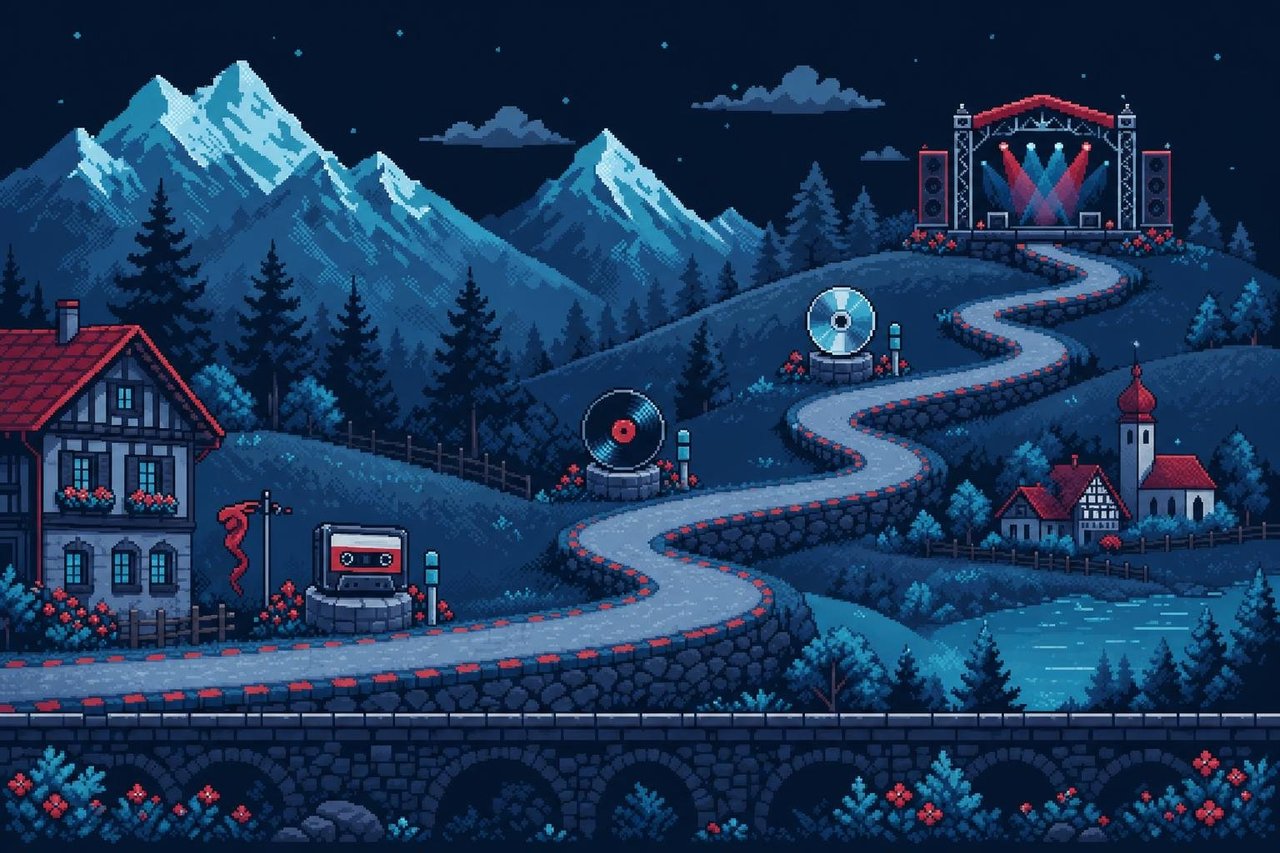
Sieges Even history 1985–2008 at a glance
| Years | Chapter | Releases |
|---|---|---|
| early 1980s to 1987 | A first band in Munich, the name Sieges Even, demo tapes | Symphonies of Steel (1986) |
| 1988 to 1992 | Signed to SPV’s Steamhammer imprint | Life Cycle (1988), Steps (1990), A Sense of Change (1991) |
| 1993 to 1997 | The Holzwarth brothers with new members, Under Siege Records | Sophisticated (1995), Uneven (1997) |
| 1997 to 1999 | Standstill, separate careers | none |
| 1999 to 2003 | Looking-Glass-Self, then Val’Paraiso | promo CD Equinox, demo “Where Our Shadows Sleep” |
| 2003 to 2008 | Sieges Even again, InsideOut Music | The Art of Navigating by the Stars (2005), Paramount (2007), Playgrounds (2008) |
| 20 September 2008 | Split announced | none |
Few German bands of the period changed shape as often as this one and still sounded like themselves on every record. The constant was a rhythm section of two brothers, Oliver Holzwarth on bass and Alex Holzwarth on drums, with guitarist and lyricist Markus Steffen as the third pillar for most of the run. Around them came and went five singers, a second guitarist, a keyboard player and a replacement guitarist for the mid-1990s. The full cast with dates is on the members page; what follows is the order in which it happened.
Where the band biography begins: Munich and the demo tapes
Any Sieges Even biography starts in Munich, and so does this band biography, which follows the group from 1985–2008 and through every one of its line-up changes. In the early 1980s Markus Steffen and Oliver Holzwarth put together their first band, and Oliver’s younger brother Alex joined on drums, as did a singer named Franz Herde. By 1985 the group was calling itself Sieges Even. In autumn 1985 the line-up briefly had a second guitarist, Markus Burchert, who played on the first demo and then left.
The naming question has never quite gone away. Early metal reference works give the band’s first name as Sodom and say it was dropped because the Ruhr-area thrash band of that name had a prior claim. The band’s own history does not mention it. Whether the founding year is 1985 or 1986 also depends on which book you open, and one German reference gives both years in different places.
What is certain is the tape trail. Demo and rehearsal recordings from 1986 and 1987 were, in the band’s words, “highly acclaimed by the underground press”. Only two titles appear consistently in every listing: Symphonies of Steel from 1986 and the four-track Repression and Resistance from 1988. Most of Sieges Even history before 1988 survives as little more than those titles. The second tape did the work that mattered. It reached the producer Kalle Trapp and the label SPV, and the band signed to SPV’s Steamhammer imprint.
The SPV years: Life Cycle, Steps and A Sense of Change
Life Cycle (1988)
In spring 1988 the four musicians went to Kalle Trapp’s Karo-Studio in Münster and recorded Life Cycle. The opening track took its title from the demo, “Repression & Resistance”, and the album ran to seven tracks in a little under 44 minutes, two of them instrumentals. It is a technical thrash record at heart, but one that refuses to stay in a single metre for long. Critics repeatedly named the American band Watchtower as the obvious comparison.
The songs had titles to match the ambition: “Apocalyptic Disposition”, “Straggler from Atlantis”, “David”, plus the instrumentals “The Roads to Iliad” and “Arcane”. The lyrics leaned towards politics and philosophy. The Metal Crypt, writing in 2012, found the record tiring but rewarding and called it a cult album worth tracking down, while a user review on DeBaser heard thrash roots with jazzy progressive passages and thought the vocals held it back. Both are fair descriptions of the same 44 minutes.
Steps (1990)
The second album was recorded in March and April 1990 at Lakeside Studios in Utting on the Ammersee, near Munich. Charlie Bauerfeind produced it together with the band, beginning a partnership that would last through four albums. Steps opened with “Tangerine Windows of Solace”, a piece of around 25 minutes, nearly half of a 55-minute record. The rest of the album ran through four shorter pieces, among them “Corridors” and “The Vacuum Tube Processor”, and closed on the two-part “Anthem”. German references also report that Herde left for a short time in 1990 and returned for these sessions, and that Steamhammer put out a split release with Napalm for the Japanese market the same year.
The touring side of 1990 went badly. Sieges Even were scheduled to join Psychotic Waltz on that band’s first tour, and the tour was cancelled after an injury. A support slot on a Fates Warning tour went to another band. In 1991 the band did get to share a stage with Psychotic Waltz, as support at a single show: the band’s own account places it in Verl, other sources in Werl on 21 July 1991, and the two are different towns. The set mixed songs from the first two albums with one new piece.
A Sense of Change (1991)
The third album brought the first big change of personnel. During the 1991 sessions with Bauerfeind, Franz Herde left. The band tried some of the material with a female singer from the USA whose name was never published, and after about three months chose Jogi Kaiser, who then sang the entire album in three days. A string quartet of viola, cello and two violins joined on several tracks, and the band later described the album as one of the first recordings made entirely in digital (DDD). A review of the 2024 reissue places the sessions at AHA Studio in Munich. Eight songs made the final running order, from “Prelude: Ode to Sisyphus” to “These Empty Places”, with “Change of Seasons” as the one most often singled out. RevelationZ, reviewing it in 2014, summed up the band in one line: “Every Sieges Even album has been different from the last”. A Sense of Change is softer and more melodic than its predecessors, closer to art rock in places, and it has aged well. Some listings date it to 1992; the release year everywhere else is 1991.
The band played its last show of this era in Wiesbaden in summer 1992. Markus Steffen left afterwards “for personal reasons”.
The 1990s line-up changes: Sophisticated and Uneven
The Holzwarth brothers did not stop. From 1993 they worked with a new guitarist, Wolfgang Zenk, and a new singer, Greg Keller. Two albums came out on Under Siege Records, both again produced by Bauerfeind with the band. Sophisticated followed in 1995 with eleven songs (“Reporter”, “Troubletalker”, “Mindjourney”). Uneven followed in 1997, with Greg Keller’s brother Börk Keller adding keyboards, and closed on the seven-minute “Love Is As Warm As Tears”. At 44 minutes, with titles like “What If?”, “Trainsong” and “What’s Up God?”, it is the more playful of the two.
These two albums are rarely discussed today, which is a pity, because Rock Hard took Uneven seriously. Its reviewer placed the band on the same level as Mekong Delta, heard the jazz-metal passages as leaning towards Cynic, and Michael Rensen judged the album the winner in a direct comparison with Dream Theater. German references also list an appearance at Wacken Open Air in August 1996.
Then the band stalled. In 1997 Börk Keller suffered a sudden hearing loss, and activity nearly came to a halt. In October 1999 Rock Hard reported that Sieges Even no longer existed.
The years apart
The gap between 1997 and 1999 is the longest pause in Sieges Even history, and none of the three core musicians spent it idle. The Holzwarth brothers played with Emerson, Lake & Palmer on tour. Oliver began working as live and session bassist for Blind Guardian, and both brothers joined Paradox in 1999. Alex started with Rhapsody, later Rhapsody of Fire, whose own records date his first tour with them to 2000.
Steffen went in a different direction entirely. He concentrated on classical guitar, released a solo album, Unsheltered Places, in 1999 and published a guitar book the same year. Anyone who knows only the 1988 debut would hardly guess that the same player made both records, which says something about how wide his range was all along.
From Looking-Glass-Self to Val’Paraiso
In summer 1999 Steffen and the Holzwarths rehearsed together for the first time in six years. The first song they wrote was “Equinox”. Rather than revive the old name, they called the project Looking-Glass-Self and recorded a promo CD, Equinox, with André Matos of the band Angra on vocals. Its four songs were “Equinox”, “Stigmata”, “Footprints of Angels” and “The Valparaiso Dreaming”; reference works date the recording to 2000. Matos was committed to his own projects and never became a member, so the search for a singer went on.
It ended with an email. Around 2002 the Dutch singer Arno Menses, from Rotterdam and originally a drummer, wrote to Steffen. In January 2003 Menses recorded vocals for “The Lonely Views of Condors” and “Where Our Shadows Sleep” over backing tracks that had been recorded roughly a year earlier. The new line-up took the name Val’Paraiso. Corny Bartels recorded and mixed a demo of “Where Our Shadows Sleep” at Weltraum Studios in Munich in 2003, and on 29 May 2003 the band played the Nachtgalerie in Munich under that name.
By the end of 2003 the musicians had gone back to Sieges Even. The return was made public in April 2004.
Reunion and the InsideOut years
The first show under the old name came on 4 April 2004 at the Headway Festival in the P60 in Amstelveen, near Amsterdam, where the band was billed alongside Watchtower. On 28 October 2004 Sieges Even played the Nachtleben in Frankfurt, their first German show in seven years. The same year their manager, Mike Möller, secured a contract with InsideOut Music.
The Art of Navigating by the Stars appeared in September 2005, produced by the band with Uwe Lulis. It is a 63-minute record in which each song carries a “Sequence” number from I to VIII after a short intro, and it includes “Stigmata” from the Looking-Glass-Self demo. Menses’ deep, mellow voice changed the band’s sound more than any earlier singer had, and reviewers noted that the album has no keyboards at all. The reviews were enthusiastic: laut.de recommended it outright and Metal Temple gave it 9 out of 10. The supporting tour ran from December 2005 to January 2006, from Larissa and Athens to Moscow and then across the Netherlands, Belgium, Switzerland and Germany; the dates are listed on the live page.
Paramount followed in autumn 2007, co-produced with Kristian Kohlmannslehner. Melody now came before technique, a shift most reviewers welcomed: Metal Express Radio gave it 9.5 out of 10 and the Danish Power of Metal 92 points, while Get Ready to Rock heard AOR touches for fans of Asia and Yes and stopped at three stars. Release dates differ by territory, between late September and 1 October 2007. On the album, the 2003 demo song “Where Our Shadows Sleep” finally appeared on an album, with lyrics by Steffen and music credited to all four members. A European tour in October 2007 took in twelve shows, from the Metropolis in Munich to ProgPower Europe in Baarlo and the Spirit of 66 in Verviers. German sources add a Rock Hard Festival appearance in Gelsenkirchen on 11 May 2008.
The last release came in July 2008: Playgrounds, produced by Uwe Lulis, the only live recording in Sieges Even history. Its ten tracks lean heavily on the two InsideOut albums, with “The Waking Hours” and “These Empty Places” as the only nods to 1991. Several reviewers wished for more of the older material.
The 2008 split and after
The Sieges Even split was announced on 20 September 2008, two months after Playgrounds. The statement gave “internal differences” as the reason, and Blabbermouth, which carried the news, noted that no further information was available. None has appeared since. For a band that had already survived a standstill and a change of name, the end came quietly.
The two halves of the last line-up went separate ways. Steffen and Menses turned a side project into a full band, Subsignal, which released Beautiful & Monstrous in 2009 and has continued with Touchstones (2011), Paraíso (2013), The Beacons of Somewhere Sometime (2015), La Muerta (2018) and A Poetry of Rain (2023). The Holzwarth brothers formed Brutal Godz with Charly Steinhauer and Uwe Lulis; its debut, Echoes of the Dead, was announced in March 2011. Oliver joined Rhapsody of Fire as bassist from September 2011 to August 2014, while Alex stayed on drums there until his departure was announced in October 2016. No reunion has followed the Sieges Even split in the years since.
A Sieges Even biography written in 2008 would have stopped there, after more than two decades of line-up changes and two long pauses. The band biography of 1985–2008 has a short coda, though. Since then the label Golden Core has reissued the SPV-era albums: a remastered LP of Life Cycle in 2022, Steps on CD and LP in 2024, and A Sense of Change in September 2024 with its first ever vinyl pressing and new liner notes by Steffen. The remastered Steps is the one to look for if you collect booklets, because its booklet carries a new interview with Steffen.
Questions and answers
When was Sieges Even formed?
The band grew out of a group that guitarist Markus Steffen and bassist Oliver Holzwarth started in Munich in the early 1980s. The name Sieges Even was in use by 1985. Reference works give 1985 or 1986 as the founding year, depending on whether they count from the name or from the first line-up under it.
Was Sieges Even first called Sodom?
Early metal reference works give the band's first name as Sodom, dropped because of the thrash band of the same name from the Ruhr area. The band's own account of its history does not mention it, so the claim rests on those reference books alone.
Why did Sieges Even split up in 2008?
The split was announced on 20 September 2008 and put down to internal differences. Nothing more detailed was made public. Markus Steffen and Arno Menses carried on with Subsignal, the Holzwarth brothers with Brutal Godz and Rhapsody of Fire; see the members page.
Did Sieges Even ever tour with Psychotic Waltz?
No full tour took place. A tour planned after Steps in 1990 was cancelled because of an injury. The two bands did share a bill once, in 1991, when Sieges Even played as support for Psychotic Waltz.
Have Sieges Even reunited since 2008?
No reunion has been announced since the 2008 split. The band's catalogue has come back in another form: remastered reissues of Life Cycle, Steps and A Sense of Change appeared between 2022 and 2024.